


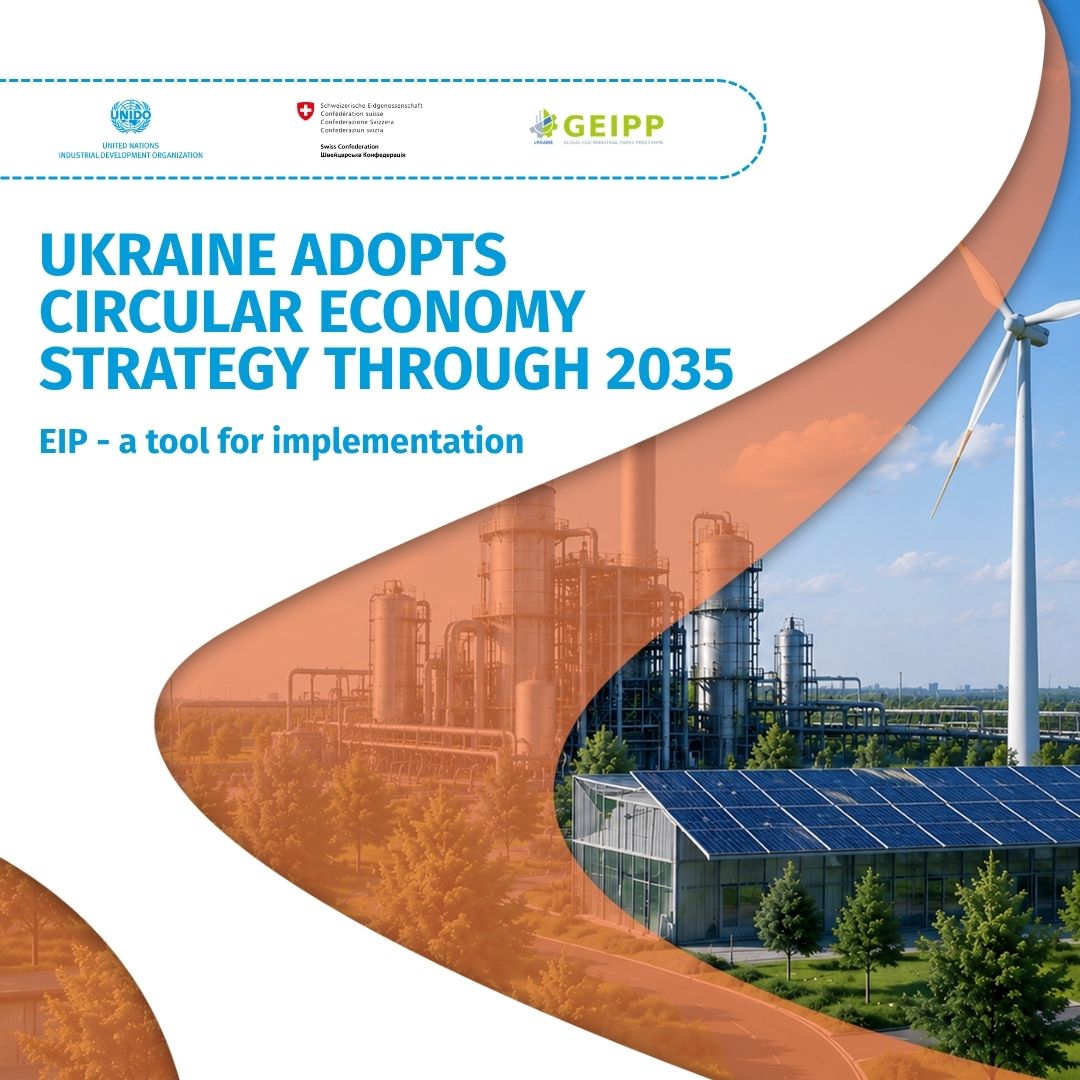
On 17 September, the Government approved the Circular Economy Development Strategy of Ukraine through 2035. The document is part of Ukraine’s European integration process and envisages a transition from an approach focused primarily on waste management to a broader model based on resource efficiency, reuse, recycling, and circular value chains.
For industry, the key elements of the Strategy are eco-industrial parks and industrial symbiosis.
The document explicitly identifies the problem: today, industrial parks and industrial zones largely operate without sufficient coordination in the shared use of resources, energy, and engineering infrastructure. This limits opportunities to create local value chains and scale up circular solutions.
This is where the eco-industrial park model gains practical importance: by-products, waste, energy, or water from one enterprise can be used as a resource by another. Companies can share infrastructure, improve resource efficiency, and create new production linkages.
For businesses, circularity means preserving the value of resources, reducing dependence on primary raw materials, and creating new value chains.
For Ukraine, it is an opportunity to rebuild industry based on the principles of resource efficiency and circularity, while strengthening economic resilience and integration into the EU internal market.
