


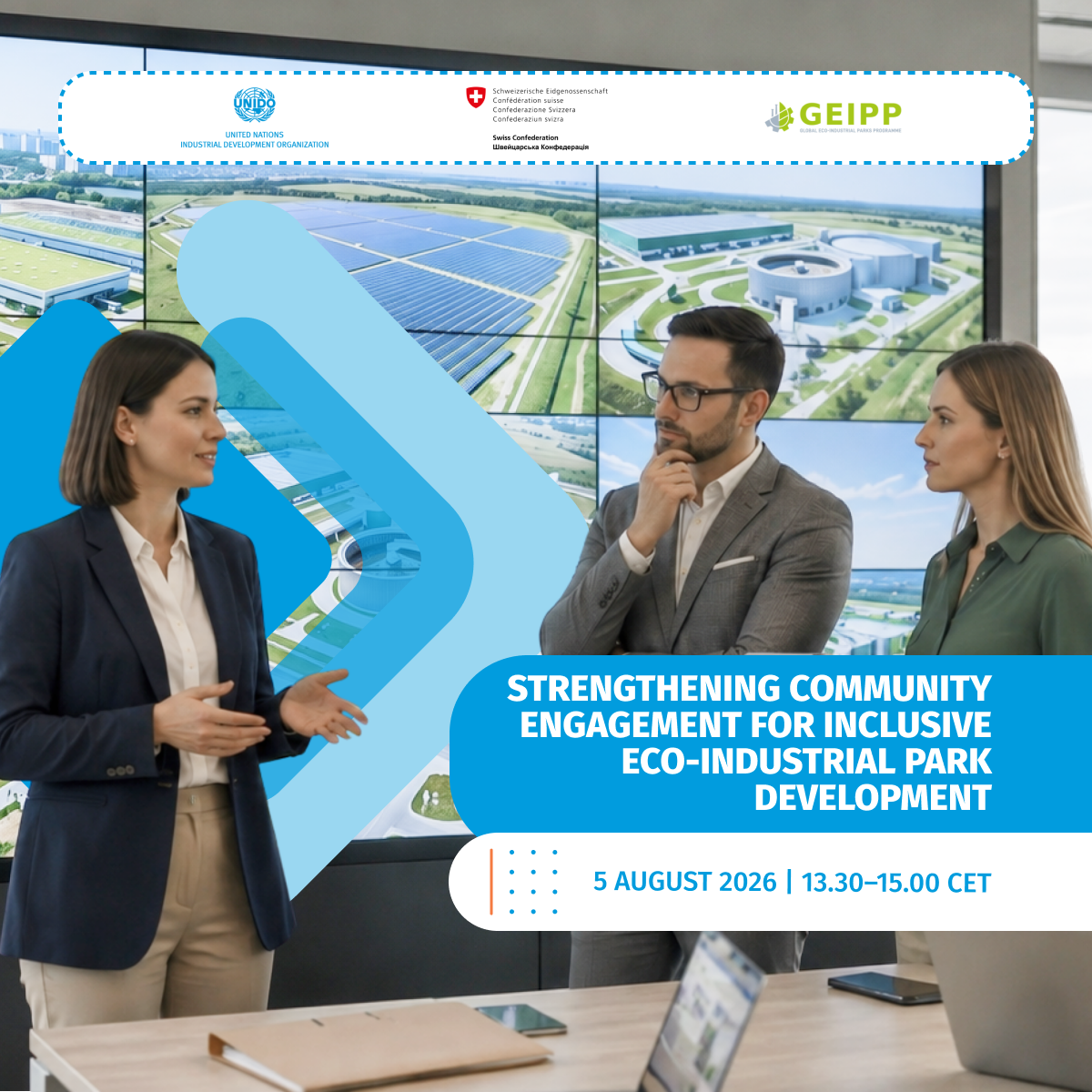
On 5 August, the Global Eco-Industrial Parks Programme (GEIPP) holds an online Best Practice Series session on how industrial parks engage the communities around them. Ukraine’s Marijany Industrial Park will present its case. Live interpretation into Ukrainian will be available.
The long-term success of an eco-industrial park rests on more than coordination between government and industry. It also depends on how a park builds its relationship with the people living next to it. Those communities shape local demand, either support or block development, and should see tangible benefit from it.
The workshop “Strengthening Community Engagement for Inclusive Eco-Industrial Park Development” takes place on 5 August 2026, 13:30–15:00 Vienna time (14:30–16:00 Kyiv time), online. Live interpretation will be available in English, French, Indonesian, Spanish, Vietnamese and Ukrainian.
The Ukrainian case
In the session “Fostering connections within the local community”, Ms. Oleksandra Fidkevych will present the experience of Marijany Industrial Park, which works with the GEIPP-II Ukraine project.
The agenda also features Mr. Michael Webster and Mr. Hardley Smith (Atlantis SEZ, South Africa) on eco-industrial parks and community engagement, and Mr. Haris Ariyanto (Karawang International Industrial City, Indonesia) presenting a women-led textile waste upcycling case. An open Q&A closes the session.
Why this matters for Ukrainian communities
Experience across GEIPP countries shows that structured community engagement delivers concrete results for a park: it strengthens social acceptance and legitimacy, improves transparency between industry and residents, surfaces social and environmental concerns early enough to resolve them, and supports inclusive local economic development and job creation.
For Ukraine, the topic carries an additional dimension. The social component is built into DSTU 9328:2025, Ukraine’s National Eco-industrial park Standard, aligned with the International Framework for Eco-Industrial Parks.
An eco-industrial park is a business model, not a “green” status. Within that model, the community is not a bystander: it gains jobs, skills, and a stable development base without environmental cost.
Who should join
The session will be useful for local government and community representatives, industrial park managers, resident enterprises, and specialists working on sustainable industrial development.
The GEIPP-II Ukraine project is implemented by the United Nations Industrial Development Organization (UNIDO) in partnership with the Ministry of Economy and Environment of Ukraine, with funding from the Government of Switzerland through the State Secretariat for Economic Affairs (SECO).
