


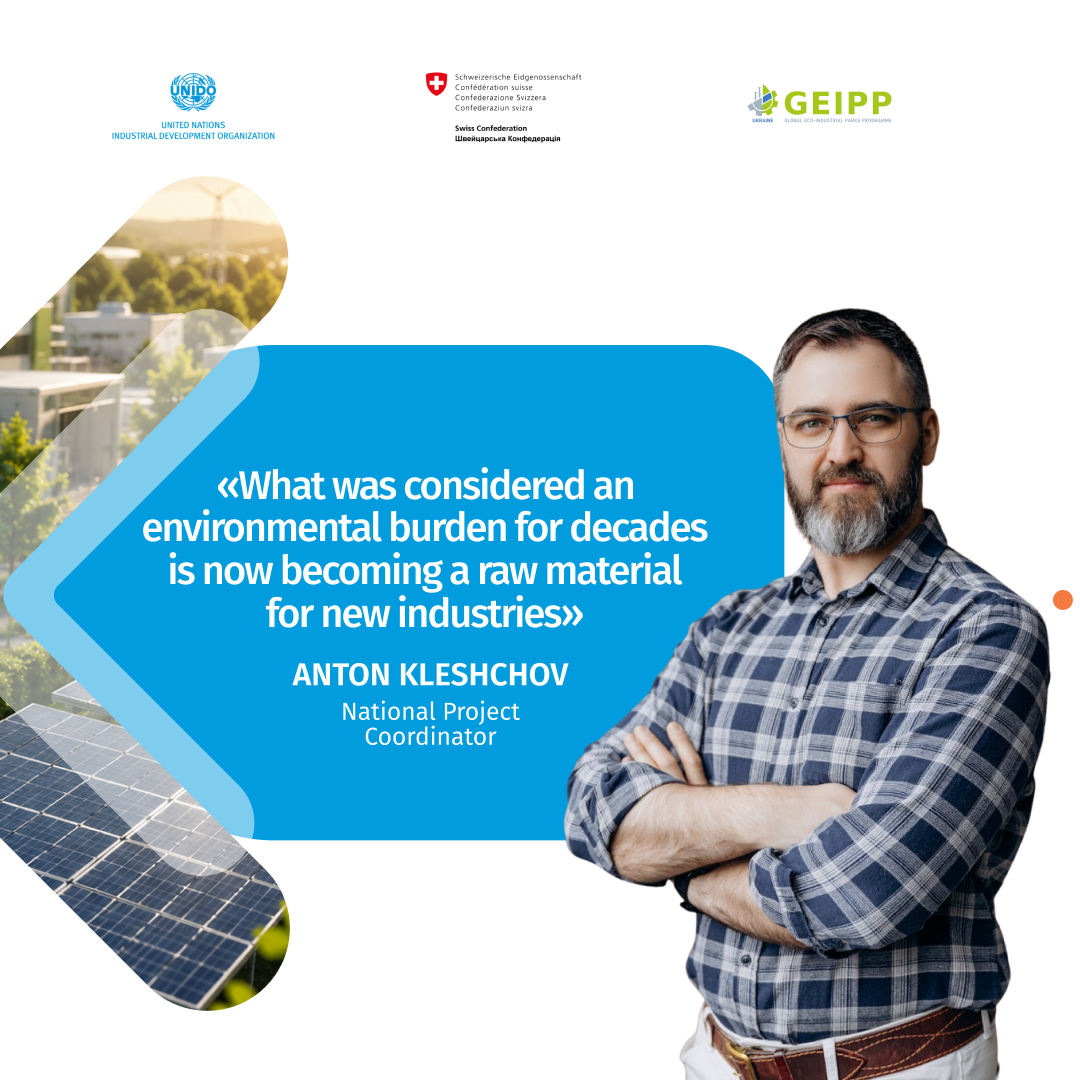
Anton Kleshchov, National Coordinator of the GEIPP-II Ukraine project (UNIDO)
In late May, the Government approved the Strategy for the Development of Industries Based on Strategic and Critical Minerals through to 2056. It is a long document with a 30-year planning horizon, and it would be easy to pass it by as yet another declaration. But a closer look at Strategic Goal 4 and the operational plan reveals something much more concrete: a set of specific initiatives.
First, some context. The global market for key energy transition minerals is growing rapidly: according to the International Energy Agency, it doubled in just five years, and demand for lithium, graphite, rare earth elements and other materials will keep rising as clean technologies develop. Yet what matters most is not the size of the market but its concentration, which is deepening. According to the agency’s estimates, in processing and refining, where raw materials are turned into usable materials, China controls over 90% of global refining capacity for graphite and rare earth elements, and remains the leading refiner for 19 of the 20 strategic minerals.
Europe depends on imports of these materials. Ukraine, with its own mineral deposits, is well positioned to respond to this demand. This is why the Strategy focuses not on exporting raw materials, but on building complete value chains: from extraction and beneficiation through to complex technological products.
And now the most interesting part. One of the four strategic goals is the development of the circular economy: recovering critical materials from waste and recycling them. Among the indicators for achieving this goal, the document explicitly names the creation of pilot eco-industrial parks engaged in recycling critical raw materials.
This is not a rhetorical mention. The operational plan for 2026–2028 assigns the Ministry of Economy and Environment, together with the Ministry of Finance, the task of drafting and submitting legislation on optimising the operating models of eco-industrial parks with a focus on recycling such waste, improving the regulatory and institutional model of industrial parks in line with international efficiency standards and environmental and energy management systems.
In other words, the state has committed to ensuring that industrial parks operate in line with international standards. This is precisely what the GEIPP-II Ukraine project, implemented by UNIDO, has been working on in recent years.
Industrial symbiosis is ceasing to be a textbook term
Here is another detail that is easy to miss but worth noting. The Strategy mentions industrial symbiosis several times, meaning a situation where the waste or by-products of one enterprise become raw material for another. And it mentions this not in the abstract, but tied to specific value chains:
- in titanium, through the creation of a chemical cluster based on the Irshansk group of deposits and support for cooperation between enterprises to produce both titanium products and by-products;
- in graphite, explicitly “through the mechanism of industrial parks”;
- in manganese, through incentives for industrial park participants, including for building a full battery production cycle.
Industrial symbiosis is one of the core elements of the eco-industrial park model. In other words, the approach set out in the Strategy already has a practical vehicle for implementation: industrial parks. .
Why this is not a “green add-on” but the economy of the future
Among the Strategy’s targets is the recycling of 50% of industrial tailings and slag, meaning the return of more than 100 million tonnes of material to economic circulation. What was considered an environmental burden for decades is now becoming a raw material for new industries.
But this material has to be processed somewhere. It requires sites with prepared infrastructure, energy, water and permitting, and, crucially, with enterprises located nearby, allowing these material flows to circulate efficiently. That is an industrial park. And when it is built on EIP principles, with shared infrastructure and services, resource efficiency and sound waste management, it turns from a site for lease into a functioning industrial ecosystem.
Let me add one more item from the operational plan that is worth highlighting: by the first quarter of 2027, geospatial mapping is to be carried out and at least 10 zones identified for the formation of industrial clusters. For territorial communities and business, this is a direct signal: the map of the country’s future industrial geography is being drawn right now.
What can be done today?
Waiting until the law is adopted before taking action is not the most effective strategy. In reality, much of the toolkit already exists.
Ukraine has adopted the national eco-industrial park standard DSTU 9328:2025, harmonised with the International Framework for Eco-Industrial Parks. A network of pilot parks is already applying EIP model approaches in practice, and these can be scaled up to new industrial park initiatives. Practical tools are available for reviewing park development plans, assessing resource efficiency and accessing finance, free of charge through international technical assistance.
So for businesses that want to be actors in this new industrial geography, I would advise starting with three things. First, take an honest look at your specialisation in its regional context: are there waste streams or processing capacities nearby with which symbiosis could be built? Second, develop or review your plans for alignment with international EIP approaches, since these are the standards the state intends to embed in the updated model. Third, do not wait for the draft law, but build capacity wherever possible now, while the zones, chains and pipelines of priority projects are being formed.
A 30-year strategy is a long horizon. But the operational plan runs to 2026–2028, and the first decisions are already being prepared for adoption. The businesses and communities that reach this point with clear plans and a vision, rather than an intention to develop them one day, will be the players on Ukraine’s new industrial map.
The GEIPP-II Ukraine project is implemented by the United Nations Industrial Development Organization (UNIDO) in partnership with the Ministry of Economy and Environment of Ukraine, with funding from the Government of Switzerland through the State Secretariat for Economic Affairs (SECO).
